Looking Beyond the Obvious: Why Small Businesses Need Better Business Diagnostics
Many small business owners judge performance by what they can easily see. Revenue, customer numbers, or monthly expenses often become the primary indicators of success. While these measures are important, they rarely reveal underlying operational weaknesses that gradually reduce resilience. A business may appear healthy on the surface while hidden inefficiencies, communication gaps, or inconsistent processes quietly affect long-term performance.
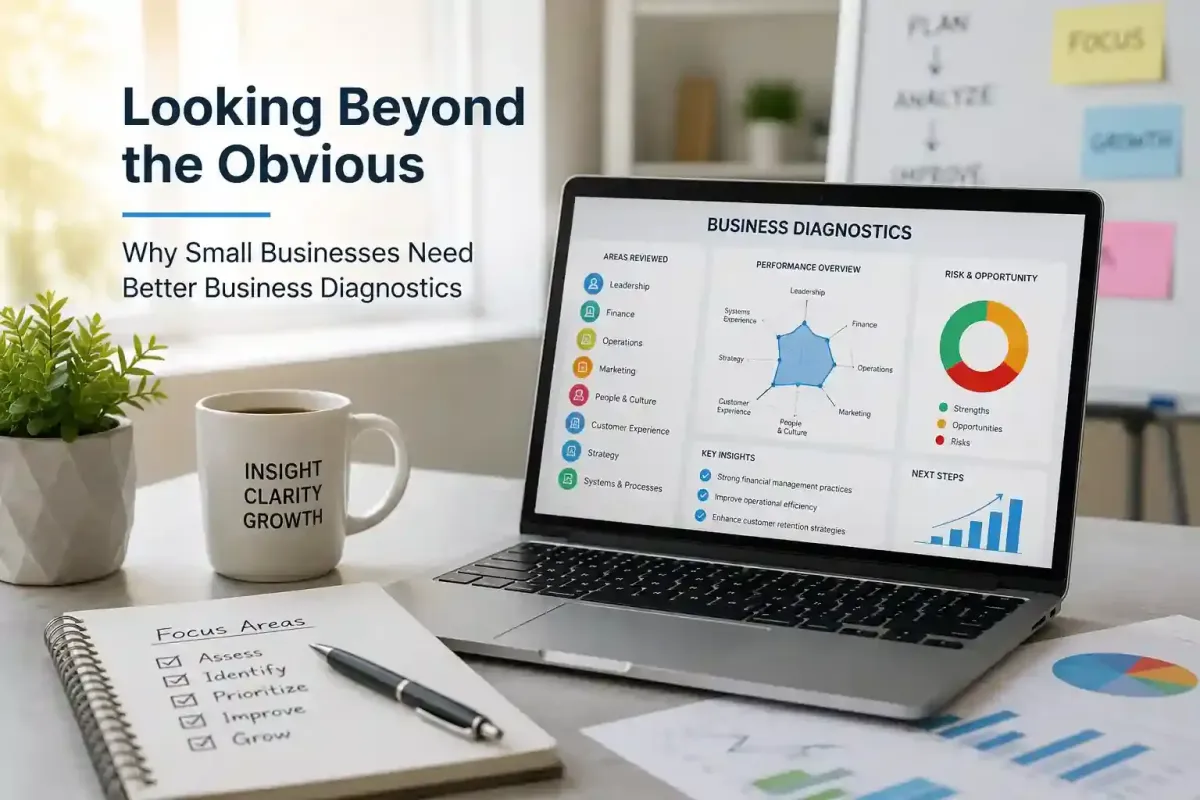
Effective business diagnostics aim to identify these less visible issues before they become significant problems. Rather than concentrating on isolated symptoms, structured assessments encourage owners to examine the relationships between leadership, finance, operations, customer experience, marketing, workforce capability, and strategic planning. Looking at the organisation as a complete system often produces insights that individual performance metrics cannot provide.
Businesses using structured assessment frameworks, including those available through the EzySWOT Business Assessment, typically gain a more balanced understanding of both risks and opportunities across multiple areas of operation.
Seeing Patterns Instead of Individual Problems
Business challenges rarely exist in isolation. Declining customer retention, for example, may initially appear to be a marketing issue. A closer examination could reveal inconsistent service delivery, unclear internal procedures, or inadequate staff training. Likewise, cash flow difficulties may stem from pricing decisions, inefficient project management, or delayed communication rather than financial management alone.
This interconnected nature makes systematic diagnostics particularly valuable. By examining multiple business functions simultaneously, owners are better positioned to identify root causes instead of continually responding to individual symptoms.
An objective review process also reduces the influence of personal assumptions. Business owners naturally develop habits and routines over time, making it easy to overlook areas that no longer operate efficiently. External frameworks encourage questions that internal teams may no longer think to ask, creating opportunities for practical improvements that support sustainable growth.
Rather than producing immediate solutions, a thorough diagnostic process provides a clearer picture of where attention should be focused first. That clarity often becomes the foundation for better operational decisions over the months and years ahead.
Skills and Capability Are Often Hidden Business Assets
One area that frequently receives less attention during business reviews is workforce capability. Equipment, technology, and financial systems are visible investments, while employee skills can be more difficult to evaluate despite having a direct influence on productivity and customer relationships.
Communication, in particular, affects nearly every aspect of business performance. Misunderstandings with clients, unclear documentation, inconsistent onboarding, and ineffective collaboration between team members can gradually reduce efficiency without attracting immediate attention.
For businesses employing multilingual teams or supporting employees who use English as an additional language, ongoing language development may form part of broader professional development initiatives. Educational providers offering English coaching for professionals contribute to this wider employment and skills landscape by helping individuals strengthen workplace communication, although language training represents only one component within an organisation's overall capability development strategy.
When business diagnostics consider workforce capability alongside operational systems, leadership, and financial performance, decision-makers gain a more realistic understanding of where improvements may have the greatest long-term impact.
Better Decisions Begin with Better Questions
Many successful businesses do not avoid challenges because they have perfect systems. Instead, they create regular opportunities to examine how those systems perform as circumstances change. Markets evolve, customer expectations shift, technology advances, and internal processes that once worked well may gradually lose effectiveness.
Business diagnostics encourage organisations to replace assumptions with evidence. Instead of asking whether sales increased this quarter, leaders may ask why customer retention improved, whether operational capacity matches future demand, or which internal processes create unnecessary friction.
These questions often reveal practical improvements that support stronger decision-making without requiring dramatic organisational change. Small adjustments to workflows, communication practices, planning processes, or resource allocation can collectively strengthen business resilience over time.
Ultimately, sustainable business performance depends less on reacting quickly to visible problems and more on developing a disciplined approach to understanding how every part of the organisation contributes to long-term success. Structured diagnostics provide one practical way of maintaining that broader perspective while helping businesses prepare for challenges that may not yet be immediately visible.